
Global Forest Loss Hits Unprecedented Levels in 2024 as Wildfires Surge
The world experienced an unprecedented level of forest destruction in 2024, largely driven by a dramatic increase in wildfires linked to climate change, according to newly released data.
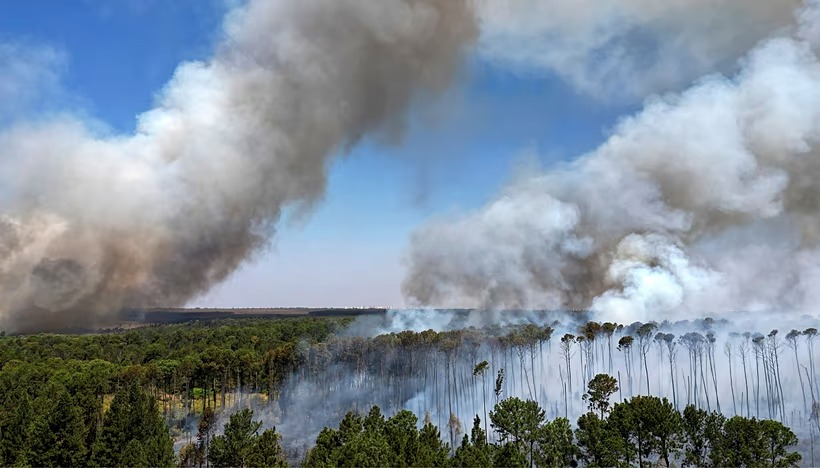
Figures from the University of Maryland’s GLAD Lab, published via the World Resources Institute’s Global Forest Watch platform, reveal that tropical primary forest loss alone reached 6.7 million hectares last year. This marks a doubling compared to 2023 and represents an area nearly equivalent to the size of Panama—roughly 18 football fields disappearing every 18 minutes.
For the first time since records began, fires overtook agriculture as the leading cause of forest loss, accounting for nearly half of all destruction. The scale of damage was striking, with wildfires burning five times more tropical primary forest than in the previous year. Latin America emerged as the region most severely affected.
These fires also released approximately 4.1 gigatons of greenhouse gases—more than four times the emissions generated by global air travel in 2023.
Experts say the scale of loss is unprecedented in modern records. Elizabeth Goldman, co-director of Global Forest Watch at the World Resources Institute, described the situation as a “global red alert,” warning that forests are essential to the survival of economies, communities, and ecosystems worldwide.
Although fires can occur naturally in some environments, in tropical regions they are largely human-induced, often set to clear land for agriculture. However, 2024’s record-breaking heat, intensified by climate change and the El Niño phenomenon, created extreme conditions. Severe and widespread droughts—especially across Latin America—made fires more intense, more frequent, and harder to control.
These combined pressures are also weakening forests’ ability to recover. Deforestation, coupled with climate stress, is creating a dangerous feedback loop that increases the likelihood of future fires.
Brazil accounted for the largest share of tropical forest loss in 2024, responsible for 42 percent of the global total. The country, which is set to host the COP30 climate summit later this year, faced its worst drought on record. Fires alone caused 66 percent of its forest loss, while agricultural expansion, including soy and cattle farming, also rose slightly.
Despite some progress under President Luiz Inácio Lula da Silva, experts warn that ongoing threats remain. They stress that without stronger investment in fire prevention, stricter enforcement, and sustainable land-use policies, recent gains could be reversed.
Bolivia saw one of the sharpest increases, with forest loss rising by 200 percent to reach 1.5 million hectares. For the first time, it ranked second globally, surpassing the Democratic Republic of Congo despite having significantly less forest area. Researchers say the fires have caused long-lasting environmental and social damage that could take generations to repair.
Meanwhile, the Democratic Republic of Congo recorded its highest-ever levels of primary forest loss, with a 150 percent increase compared to the previous year. Nearly half of this destruction was caused by fires, exacerbated by unusually hot and dry conditions. The Congo Basin, like the Amazon, plays a critical role as a carbon sink, but its capacity is increasingly under threat.
Colombia also experienced a sharp rise in forest loss, increasing by nearly 50 percent. However, in this case, the main drivers were linked to political instability following the collapse of peace talks, which led to increased illegal mining and coca cultivation.
The trend extended beyond tropical regions. Globally, total tree cover loss rose by 5 percent in 2024, reaching an additional 30 million hectares—an area roughly the size of Italy. Severe fire seasons in countries such as Russia and Canada contributed significantly to this increase.
Although wildfires are part of the natural cycle in boreal forests, climate change is making them more intense and longer-lasting, reducing forests’ ability to regenerate. Notably, 2024 marked the first year in which major fires simultaneously affected both tropical and boreal forests.
Despite the alarming data, some countries reported progress. Indonesia reduced its primary forest loss by 11 percent, supported by policies aimed at land restoration and fire prevention introduced under former President Joko Widodo. Malaysia also recorded a 13 percent decline and dropped out of the top 10 countries for tropical forest loss for the first time.
However, global efforts remain far off track. Although more than 140 countries pledged in 2021 to halt and reverse deforestation by 2030, current trends show insufficient progress. Of the 20 countries with the largest primary forest areas, 17 are now losing forests at a faster rate than when the agreement was signed.
Experts emphasize the urgent need for stronger fire prevention measures, stricter supply chain regulations, better enforcement of environmental laws, and increased funding for forest protection—particularly through Indigenous-led initiatives. In Bolivia, for example, the Charagua Lyambae protected area successfully limited fire spread thanks to early warning systems and effective land management, demonstrating the potential of community-driven approaches.
Scientists warn that the growing gap between international commitments and actual progress should serve as a wake-up call, highlighting the accelerating impact of a warming planet and the urgent need for decisive action.