
Top UN court rules countries can take legal action against each other over climate change
A landmark opinion from the International Court of Justice (ICJ) has opened the door for countries to pursue legal action against one another over climate change, including claims tied to historic greenhouse gas emissions.
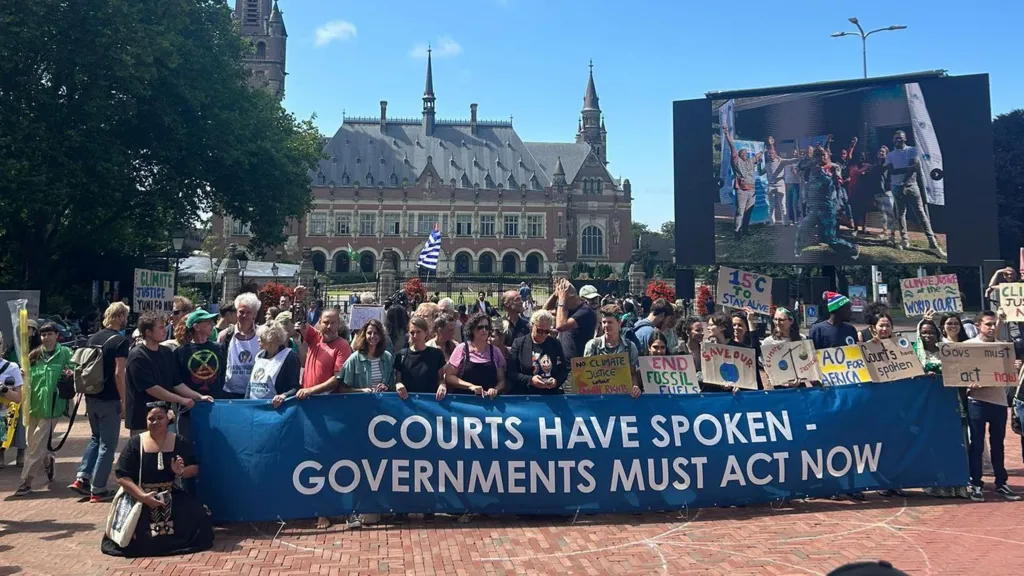
In its advisory ruling delivered in The Hague, the court stated that nations could, in principle, be held accountable for climate-related harm. However, judges also acknowledged the complexity of determining responsibility for specific impacts, noting that linking emissions to particular damages would be challenging and must be assessed case by case.
Although the opinion is non-binding, legal experts say it could have far-reaching consequences by shaping future cases in both international and domestic courts. The decision is being hailed as a major breakthrough by climate-vulnerable nations, many of which have long argued that wealthier, high-emitting countries should bear greater responsibility for the crisis.
The case was initiated by a group of students from Pacific island nations, including Tonga and Vanuatu, who first proposed the idea in 2019. These countries are among those most exposed to rising sea levels and extreme weather.
Campaigners say the ruling strengthens the legal basis for compensation claims related to climate damage, such as destroyed infrastructure or land loss. The court also suggested that failing to adopt sufficiently ambitious climate policies could violate commitments under the Paris Agreement, while broader international law obliges all states—even those outside the agreement—to protect the climate system.
Importantly, the ICJ indicated that governments may also be responsible for the actions of companies operating within their borders, including fossil fuel activities supported through subsidies or new extraction licenses.
Legal advocates believe the opinion could soon be cited in new cases worldwide. While countries can bring disputes before the ICJ only if both parties accept its jurisdiction, similar claims could also be pursued in national courts, including in major economies.
“This is a watershed moment,” said Joie Chowdhury of the Centre for International Environmental Law, arguing that the ruling affirms the right of affected communities to seek remedies, including financial compensation.
Developing nations have welcomed the decision, seeing it as a step toward accountability. Estimates suggest climate-related damages between 2000 and 2019 reached trillions of dollars globally, underscoring the scale of potential claims.
However, questions remain over enforcement. As with previous ICJ opinions, implementation depends on whether countries choose to comply, as the court has no direct mechanism to enforce its rulings.
Despite these uncertainties, the decision is widely viewed as a turning point in climate law—potentially reshaping how responsibility for global warming is addressed in courts around the world.