
“Unprecedented” Wildfire Devastates Southern France as Officials Link Blaze to Drought and Climate Change
A rapidly spreading wildfire in southern France has become the largest in the country since 1949, with authorities warning that extreme drought and rising temperatures linked to climate change have significantly intensified the disaster.
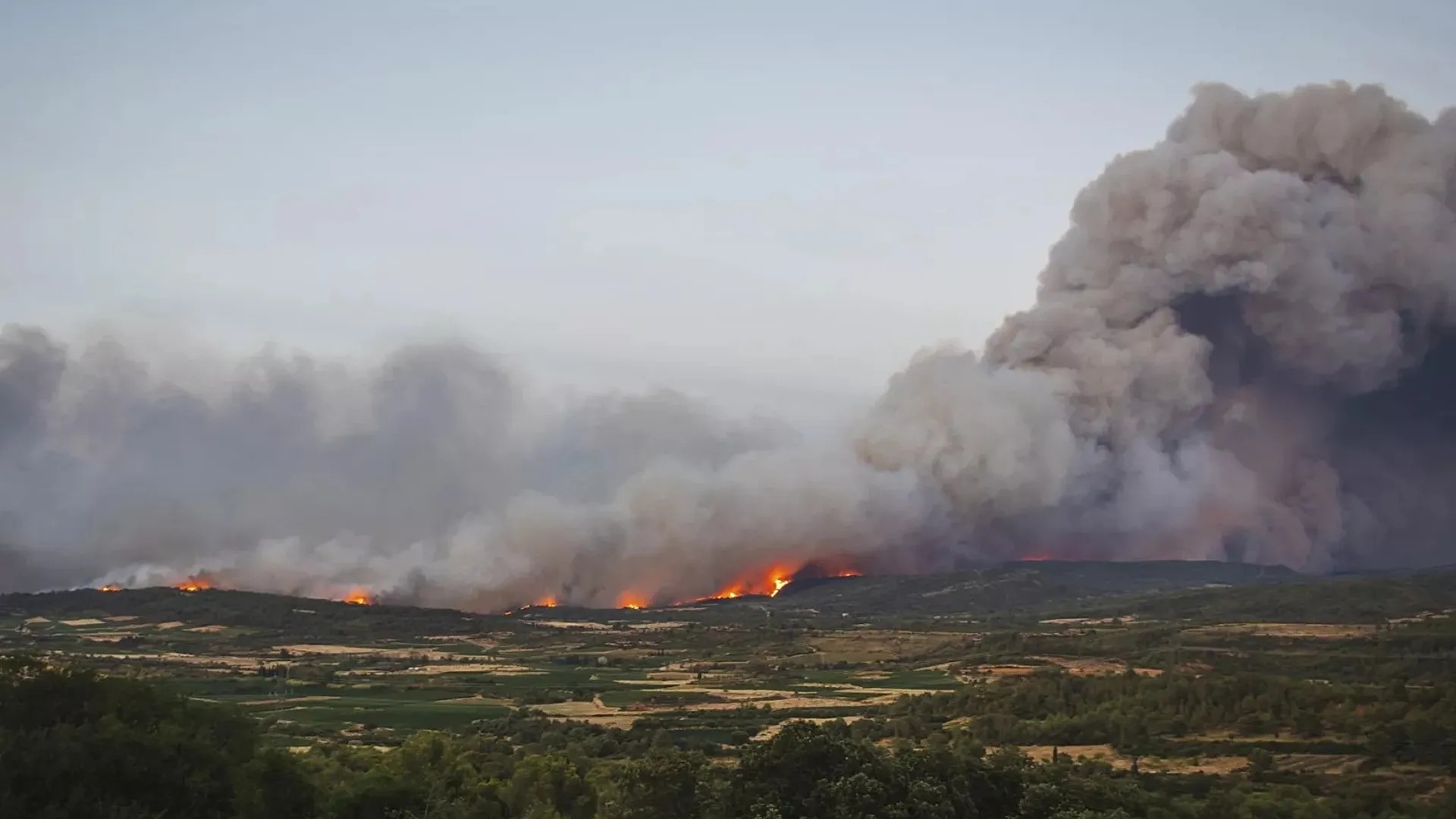
The fire, which broke out on Tuesday afternoon near the village of Ribaute in the Aude region close to the Spanish border, has already burned more than 16,000 hectares—an area roughly one and a half times the size of Paris—and claimed at least one life.
French Prime Minister François Bayrou described the event as a “catastrophe of unprecedented scale,” as firefighters continue battling the blaze for several days under increasingly difficult conditions.
Within just 12 hours of ignition, the wildfire had already consumed around 11,000 hectares, spreading at a pace far beyond typical seasonal fires in France. In its first day alone, it destroyed as much land as the country usually loses to wildfires in an entire year.
By the second day, officials confirmed it had become the largest wildfire recorded since France’s national fire database was established in 2006, with smoke plumes so large they were visible from space in satellite imagery provided by Météo-France.
Fire services reported that strong winds, dry vegetation, and persistent heat have all contributed to the fire’s rapid expansion. While slightly cooler nighttime temperatures briefly slowed its spread, authorities warned that conditions remain highly unstable.
France’s Minister for Ecological Transition, Agnès Pannier-Runacher, stated that this is the most severe wildfire the country has experienced since 1949, adding that it is clearly linked to ongoing drought conditions and climate change.
Local fire officials also cautioned that unfavorable weather, including wind gusts exceeding 40 km/h and forecast temperatures reaching up to 40°C, would likely continue to fuel the flames and delay containment efforts.
Meteorological services have warned of escalating wildfire risk across southern France, where prolonged dry periods have left vegetation highly vulnerable. The Aude region has been under drought-related water restrictions since early August, following months of below-average rainfall.
Authorities in nearby regions have also reported significant long-term rainfall declines, with some areas experiencing up to 60 percent less precipitation since 2022.
Experts say that the combination of dry vegetation, heatwaves, and changing rainfall patterns has created ideal conditions for extreme wildfires. Even mature trees, which typically resist fire, are now being affected—an indicator of the severity of the ongoing drought.
The wildfire is part of a broader pattern of increasingly destructive fire seasons across southern Europe. According to the European Forest Fire Information System, more than 353,000 hectares have already burned across Europe in 2025—more than double the area recorded during the same period last year.
Satellite monitoring shows that smoke from the French wildfire has been visible from space, highlighting the scale of the ongoing emergency.
Scientists and meteorological agencies have repeatedly warned that climate change is intensifying both drought conditions and heat extremes across the Mediterranean region. These changes are making landscapes more flammable and reducing their ability to recover between fire seasons.
Data from the European Drought Observatory indicates that over half of Europe experienced severe drought conditions in early July, marking the worst levels recorded since monitoring began in 2021.
Researchers also note that shifting rainfall patterns are reducing the reliability of seasonal recovery periods, leaving southern Europe increasingly exposed to long-lasting and more intense wildfire seasons.
As investigations continue into the exact cause of the blaze, officials stress that the combination of extreme weather and prolonged drought has created a critical and worsening fire risk across the region.