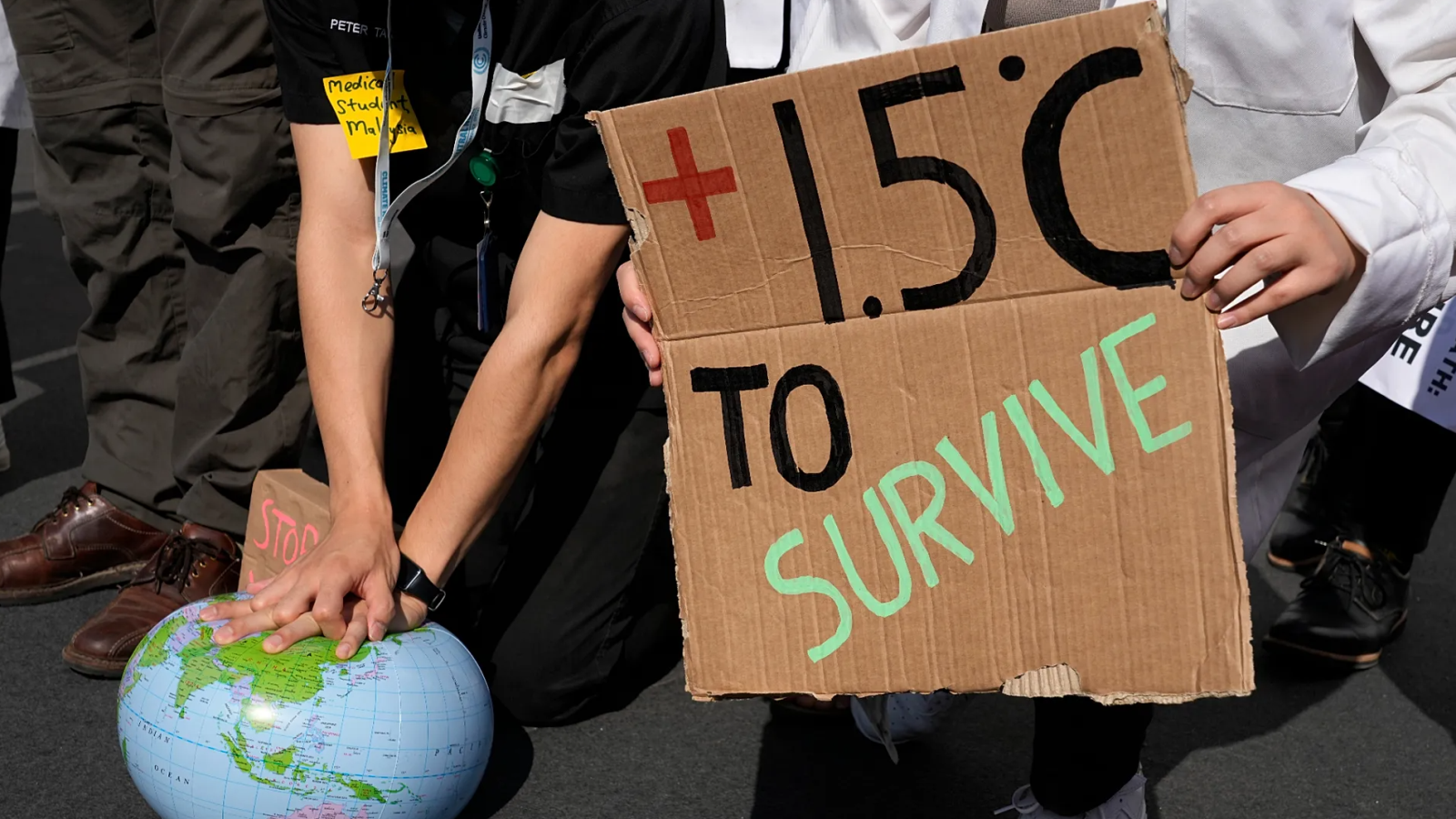
Scientists, policymakers and UN leaders are now rallying around a new message: even if the world exceeds the Paris Agreement's temperature limit, it may still be possible to bring warming back down — a scenario they are calling "overshoot."
In climate science, overshoot doesn't imply crossing the red line permanently. Instead, it describes a temporary excursion into more hazardous territory, followed by a deliberate effort to reverse course and return to safer temperature levels.
After years of describing 1.5°C as an absolute boundary, senior climate officials in recent weeks have shifted to discussing how to minimise both the depth and duration of Earth's time above that line.
‘It's a limit — not a target'
Many researchers now say crossing 1.5°C is essentially unavoidable. The threshold is defined as a 10-year global average, and although today's temperature stands at around 1.3°C above preindustrial levels, last year briefly exceeded the 1.5°C mark.
That temporary breach foreshadows what's coming — and the consequences could be severe.
"We face the real prospect of triggering irreversible shifts in major Earth systems once we cross 1.5°C," warned Johan Rockström, director of the Potsdam Institute for Climate Research and an adviser to the UN climate summit currently underway in Belém, Brazil.
Scientists caution that warming beyond the limit could spell the near-total collapse of coral reef ecosystems, dramatic increases in lethal heatwaves, and the destabilisation of critical tipping points — from the drying of the Amazon rainforest to rapid ice-sheet melt in Greenland and Antarctica, and even a potential shutdown of the Atlantic ocean circulation.
A 2018 UN climate report reached similar conclusions, framing 1.5°C as the doorway into a danger zone.
"In Belém, we have stronger evidence than ever before that 1.5°C is a boundary. It's not aspirational — it's a real physical limit," Rockström told the Associated Press. "Beyond it, suffering increases, and the risk of crossing irreversible thresholds rises sharply."
A breach looks increasingly inevitable
For years, climate analysts described 1.5°C as difficult but still technically achievable. Now, most say the world has veered too far off course.
Current policies put the planet on track for roughly 2.6°C of warming by the end of the century — far beyond both the Paris Agreement and earlier projections.
UN officials have long maintained that 1.5°C remained within reach. But in recent weeks, several have publicly accepted that the boundary is likely to be exceeded in the coming years or decades.
"The science is unequivocal: even if we overshoot, we must and can bring temperatures back down to 1.5°C," said UN climate chief Simon Stiell at the opening of this year's conference.
UN Secretary-General António Guterres was more direct: "Overshooting is now inevitable. We will spend a period — shorter or longer, more or less intense — above 1.5°C," he said in Geneva last month. "But that does not mean the 1.5°C limit is lost forever. Absolutely not."
UN leaders argue that the temperature goal remains worth defending even after the world temporarily moves beyond it.
Overshoot as a fallback scenario
The overshoot framework rests on the assumption that warming will push past the threshold before gradually falling again.
That decline would depend on the rapid elimination of emissions from fossil fuels and on the ability of natural "carbon sinks" — forests, soils, and oceans — to absorb existing pollution. It would also rely heavily on emerging technologies capable of removing carbon dioxide from the atmosphere at massive scales.
Temperatures will only fall once atmospheric carbon concentrations drop — and today, the required technologies are still largely unproven at the pace and scale needed.
"Without large-scale carbon dioxide removal, managing an overshoot is simply impossible," warned Ottmar Edenhofer, chief economist at the Potsdam Institute and chair of the European Scientific Advisory Board on Climate Change.
Scientists still don't know how long the world can safely remain in overshoot conditions or whether a short, intense spike is more dangerous than a longer, moderate overshoot. What is clear, they say, is that the planet is likely to remain above 1.5°C for decades.
New modelling from Climate Action Tracker suggests that even under the most aggressive emissions cuts — far beyond anything achieved so far — the world is likely to cross 1.5°C around 2030, peak near 1.7°C, and only fall back below the limit sometime in the 2060s.
But current trajectories point not to a brief overshoot, but to runaway warming well into the end of the century.
"A decade ago, we had a path to avoiding 1.5°C entirely, with minimal overshoot," Rockström said. "Now, ten years on, we've failed to stay on that path."