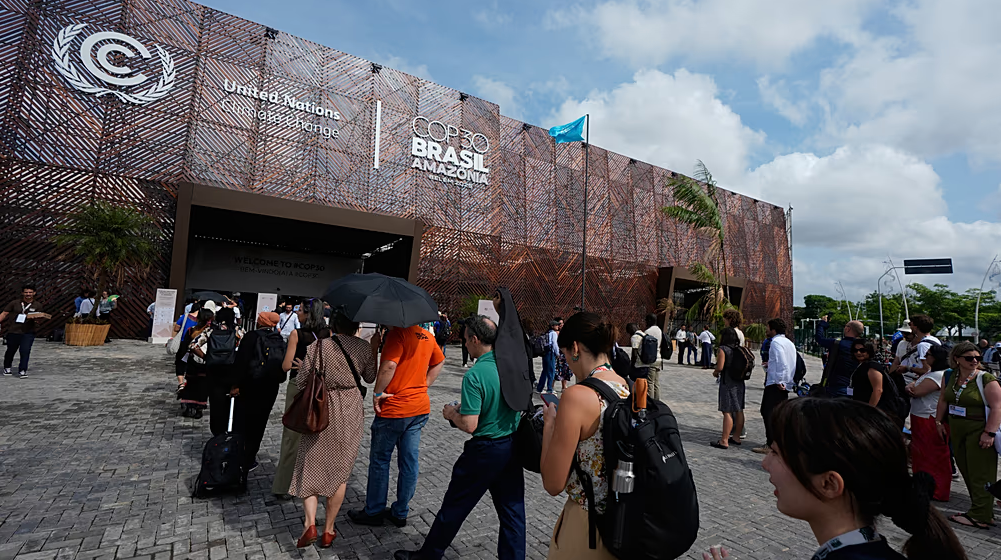
According to the Kick Big Polluters Out (KBPO) coalition, the number marks a 12% increase in fossil fuel representation compared to last year's talks in Baku, despite overall lower attendance in Brazil. Only the host country, Brazil, has sent a larger delegation, with 3,805 delegates.
Since KBPO began tracking attendance lists in 2021, this year represents the highest concentration of fossil fuel representatives ever recorded at a UN climate summit.
Who counts as a lobbyist?
The coalition's analysis draws exclusively from the UNFCCC's provisional participant list published on 10 November. It classifies a fossil fuel lobbyist as any delegate representing an organisation or institution seeking to influence climate policy in ways that advance fossil fuel interests.
This includes representatives of financial institutions that have provided significant funding to oil, gas or coal industries since the Paris Agreement was signed.
Vulnerable nations outnumbered dozens to one
The findings highlight a stark imbalance. KBPO reports that fossil fuel lobbyists outnumber official Filipino delegates 50-to-1, even as the Philippines reels from destructive typhoons during the conference period.
"Just days after catastrophic floods and supertyphoons in the Philippines, the very actors fuelling this crisis are being given space to push the same false solutions that keep their profits intact," said Jax Bonbon of IBON International.
Jamaica, still recovering from climate-boosted Hurricane Melissa, faces a similar disparity — lobbyists outnumber its delegation 40-to-1.
Overall, fossil fuel lobbyists received two-thirds more access badges than all delegates from the 10 most climate-vulnerable nations combined.
Where are these lobbyists coming from?
Major industry trade associations remain a key channel. The International Emissions Trading Association brought 60 delegates, including representatives from ExxonMobil, BP and TotalEnergies.
COP30 is the first UN climate summit requiring non-government participants to publicly disclose who funded their attendance and to confirm that their objectives align with those of the UNFCCC. But the rules do not apply to government-issued badges.
KBPO flagged this as a major loophole: 164 fossil fuel lobbyists gained access through government delegations.
Separate research by Transparency International shows that 54% of national delegation participants did not disclose their affiliation type or used vague labels such as "Guest" or "Other". Several countries — including Russia, Tanzania, South Africa and Mexico — disclosed no affiliation data for any of their Party badge holders.
"This lack of transparency threatens trust and risks skewing decisions away from people and the planet," said Maíra Martini, CEO of Transparency International.
EU hesitation — and loopholes
Earlier this year, the Fossil Free Politics coalition urged the EU to avoid bringing fossil fuel representatives to COP30. The European Commission appears to have complied, with its delegation including only three non-institutional attendees — all journalists or filmmakers.
"It's a strong signal from the Commission for the second year in a row," said Kim Claes of Friends of the Earth Europe. "But now this approach must become EU policy."
Germany and Austria also pledged not to bring fossil fuel lobbyists. Yet other EU member states brought 84 lobbyists in their official delegations, according to a joint analysis by KBPO and Fossil Free Politics.
France led with 22, including five delegates from TotalEnergies — among them CEO Patrick Pouyanné. The company has recently faced a legal setback after a Paris court ruled that its advertising misled consumers by portraying itself as part of the climate solution while continuing to expand fossil fuel production.
Sweden brought 18, Italy 12, while Denmark, Belgium and Portugal each brought between 8 and 11 representatives. Finland sent 2, and the Netherlands and Greece each included 1 fossil fuel-linked delegate.
Do the UN climate talks need stronger safeguards?
A Transparency International report released earlier this year examined how fossil fuel influence shapes the UN climate process — from foundational UNFCCC rules to the final outcomes of COP negotiations.
Brice Böhmer, the organisation's climate and environment lead, said that if COP30 is truly the "COP of truth," then the Presidency and UNFCCC Secretariat must urgently strengthen disclosure and ethics rules ahead of future climate summits.
Alongside tighter transparency requirements, the organisation is calling for fossil fuel actors to be removed entirely from national delegations.
The KBPO coalition agrees, warning that the Belém findings show the need for formal conflict-of-interest policies at the UN talks.
"We must urgently reform the rules of climate negotiations," said Lien Vandamme of the Center for International Environmental Law. That includes allowing votes when consensus is weaponised, enforcing conflict-of-interest rules, protecting civic space, and ensuring that people and science — not polluters — steer decisions on the phaseout of fossil fuels and the delivery of climate finance at scale.